
Shark catching drives species to extinction+Shark Conservation~~Please sign the Petitions
Shark catching drives species to extinction
AfSD™(ADVOCATE FOR SAVING DOGS™)
Phil
RILEY ® (http://www.myspace.com/433444049)
Shark catching drives species to extinction
By Dean Irvine, CNNSTORY HIGHLIGHTS
A third of shark species are threatened with extinction, according to conservation groupAround 73 million sharks caught each year, mainly for their finsTop shark catching countries failed to effectively manage shark stock, says new reportValue of shark sanctuaries and tourism being promoted among some countries
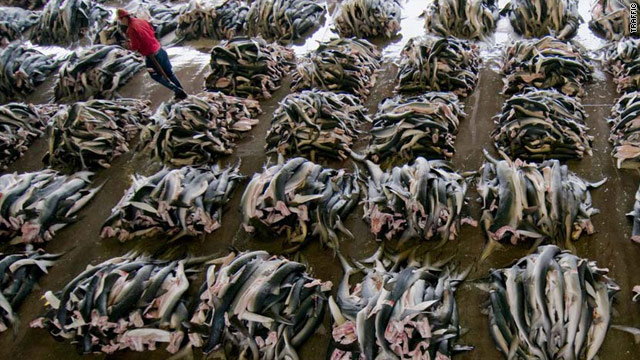
(CNN) — Last year six people were killed by sharks worldwide. Multiply that number by more than 12 million and you get close to the number of sharks killed for human consumption each year.
The annual mass slaughter of sharks, estimated to be around 73 million each year, has left one third of all shark species on the brink of extinction.
“It’s a grave situation that sharks are now faced with,” say Matt Rand, director of the Pew Environment Group’s Global Shark Conservation Campaign.
“If serious action is not taken soon, the fate of shark species playing a viable role in the marine ecosystem — one they’ve played for 400 million years — is in jeopardy. Some say we’ve past the turning point; I hope that is not the case.”
Gallery: Shark species feeling the bite
It’s in everyone’s interest to curb the massive overfishing of sharks–Scott Henderson, Conservation International
On Monday a U.N. Food and Agriculture Organization summit began in Rome to discuss the problems facing global fish stocks. Some estimate that around 70% of fishing areas are fished out or fully exploited.
A recent report from the Pew Environment Group and TRAFFIC suggests sharks fishing, particularly the practices of finning, needs to be at the top of the agenda as regulations on shark catching have failed to stop an alarming decline in their numbers.
Shark fins are increasingly sought after in Asia, particularly China, as they are used in soups and other products. Finning — where a shark’s fins are removed and the body dumped — is outlawed by the U.S. and EU, but loopholes and lack of regulation and enforcement elsewhere have meant it remains a major problem.
An international action plan for sharks has been in place for ten years, but it leaves the responsibility of sustainably managing and recording catches to each country.
While a few had made “excellent progress,” the majority of countries had not, according to the U.N.’s Food and Agriculture Organization (FAO) in 2005.
“It’s a good plan; it’s very well thought out,” says Rand. “If it was implemented we’d be seeing healthy populations. Unfortunately that’s not the case.”
Of the top four shark catchers — Indonesia, India, Spain and Taiwan — only Spain provides a breakdown on what species it is catching.
Rand hopes that the summit in Rome will provide some time for the FAO to reflect on the global dynamics of sharks, and that they will “recommit to take this international plan of action seriously and implement it.”
We’re pointing out to the shark catchers that they can make the change–Matt Rand, Pew Environment Group
RELATED TOPICS
Sharks and RaysNature and the EnvironmentWildlife
“We’re pointing out to the shark catchers that they can make the change. We hope it’s not just the NGOs just looking at what’s happening. Now is the opportunity to recommit to the international plan to save sharks,” he says.
Away from international regulations there are some bright spots in shark conservation efforts.
Palau, Honduras and the Maldives have all declared that no sharks can be caught in their waters.
“They realize that it’s very hard to have a sustainable fishery of a species that doesn’t reach sexual maturity until in its teens and then only produces a few pups every time they give birth,” says Rand.
Shark tourism is also being increasingly valued by coastal communities across the world.
Scott Henderson of Conservation International has lived in the Galapagos Islands for 20 years and witnessed the rise in diving tours in the area, the main attraction being the chance of seeing sharks.
But even the world’s most protected marine eco-system has not been immune to shark catching. Illegal shark fishing around the Galapagos does occur, says Henderson, although he believes it is under control and becoming less frequent.
“There is nothing inherently wrong with fishing, and cultural traditions must be respected. However, as the elephant ivory trade, mountain gorilla exterminations and rhinoceros horn trade tragedies all prove, both suppliers and markets need to be responsible in curbing their activities when extinctions are imminent.”
Rand describes the uncontrolled catching of sharks as a “massive experiment on the world’s oceans.”
“There’s a big question mark as to how far they will decline,” he says.
The impact of declining shark numbers on marine eco-systems and the knock-on effect on fishing industries has already been felt in regions around the world.
The rapid decline of black tip sharks in the west Atlantic Ocean since the early 1990s led to a rise in cow-nosed rays and decline in the North Carolina bay scallop industry.
“Whether you care about sharks, themselves, or the oceans they regulate, it’s in everyone’s interest to curb the massive overfishing of sharks that is putting oceans at risk,” says Henderson.
Please join me at Friendburst
Advocate for Saving Dogs™
Animal Rights
♥We♥Are♥All♥Connected♥
Wolfen Warriors
Click Here For A Complete List Of Blogs By AfSD™

RILEY ® (http://www.myspace.com/433444049)
Shark Conservation

Sharks have roamed our oceans since before the time of dinosaurs, but their long reign at the top of the ocean food chain may be ending. Overfishing has decimated shark populations around the globe and numerous studies have documented significant declines.
Some shark populations along the eastern U.S. coast, such as scalloped hammerheads and dusky sharks, have plummeted by as much as 80 percent since the 1970s. Spiny dogfish populations off Europe’s Atlantic coast are at less than ten percent of their original size. Over the last 200 years, iconic species in the Mediterranean Sea such as the smooth hammerhead, shortfin mako, porbeagle, and thresher sharks have decreased by more than 97 percent in number and catch weight.
Shark-finning – the practice of catching a shark, slicing off its fins and then discarding the body at sea – takes a tremendous toll on shark populations. Up to 73 million sharks are killed annually to support the shark fin industry, valued for the Asian delicacy “shark fin soup.”
The loss of sharks, one of the apex predators in the marine environment, can and will cause drastic and irreversible changes. For example, scientists have found that declines in sharks can contribute to a shift from healthy, coral-dominated reefs to barren, algae-dominated reefs.
Protecting Sharks Globally
The Pacific Island nation of Palau declared its waters a shark sanctuary in September, 2009. The Indian Ocean Island nation of the Maldives declared their waters a shark sanctuary in March, 2010. Both countries have taken these steps because they recognize that healthy shark populations in their waters can help drive their economies and make their seas thrive. Pew is continuing to work with both governments and calling on other countries to establish more shark sanctuaries and marine reserves, where sharks can live and breed free from over-exploitation – and can help generate tourism income.
Protecting Sharks in the United States
Pew is working for passage of the U.S. Shark Conservation Act of 2009 (S.850/H.R.81), which would completely prohibit the removal of shark fins at sea, close loopholes in the current finning law and promote shark conservation in other countries. H.R. 81, introduced by Representative Madeline Bordallo (Guam), passed the House of Representatives unanimously in 2009. Senator John Kerry (D-MA) introduced the Senate version S.850 in 2009, which cleared the Senate Commerce Committee and is awaiting consideration by the full Senate.
Protecting Sharks on the High Seas
Sharks caught in high-seas fisheries are among the ocean’s most vulnerable animals. There are no limits on the number that can be caught and no rules on what fishing is allowed and what is not. Due to overfishing and low reproductive rates, more than half of the shark species caught in high-seas fisheries are threatened or near threatened with extinction according to the International Union for Conservation of Nature (IUCN).
In the second half of 2010, Pew will work at the United Nations and at regional fisheries management organizations to set scientific limits on the number of sharks that can be caught. All fishing nations must adopt and implement shark management plans to ensure the recovery of depleted shark populations and the restoration of the critical role they play in the ocean environment.
To join the effort, and call on the world’s leaders to take concrete and meaningful action to conserve sharks globally, please sign the petition.

Save Sharks to Protect the Ocean!

Pew is a leading member of the Shark Alliance, a coalition of non-governmental organizations dedicated to restoring and conserving shark populations around the world. The coalition includes more than 90 member organizations from around the world concerned with the conservation of sharks. See www.sharkalliance.org for more information.
Added petitions
BAN THE SALE OF SHARK FINS IN GUAM ! (Deadline: March 15, 2011)
STOP SHARK FISHING IN PERU
STOP SHARK FINNING !
PETITION TO THE MALDIVES FOR BANNING SHARK FISHING